Manifesto
Exiting the seat trap and building the company that comes after it.
Most software companies are not software companies. They are sales organisations with a product attached, built around a unit the customer no longer wants to buy.
01The shift
For twenty years the unit of software was the seat. You priced it, forecast it, hired against it and built your product roadmap to fill more of them. It worked because a seat was a person, and a person did the work. That link has broken. An agent now does the work a seat used to do, and it does not log in, does not renew, and does not need a licence. The customer has noticed. They are cutting seats first and asking what they are paying for second.
This is not a pricing problem. It is an operating model problem. Every part of a sales-led company, from the comp plan to the org chart to the board deck, was engineered around a unit that is disappearing.
02Winners and losers
The losers will bolt AI features onto the seat model and call it a strategy. They will keep the pipeline, the quota and the pricing page, and add a copilot. They will look modern for a year and then discover that their customers are paying less for more.
The winners will re-engineer the operating model. They will price on the outcome the customer buys. They will rebuild the commercial motion around value delivered rather than access granted. They will cut the cost of selling, because software that acts inside a customer's process does not need a large organisation to explain it. And they will treat AI as the layer that does work, not the layer that talks about it.
03The value-led company
What comes next looks less like a venture-backed software company and more like an industrial business. Revenue tied to outcomes the customer can measure. Operating margin that would not embarrass a manufacturer. Smaller, more senior teams that own a P&L rather than a funnel stage. Software that acts, with humans approving. A company valued as a business, not as a growth story.
Industrial companies learned this a decade ago. Their customers refused to pay for capacity, so they learned to sell uptime, yield and energy per unit. Software is learning the same lesson, for the same reason: nobody pays for a seat an agent now fills.
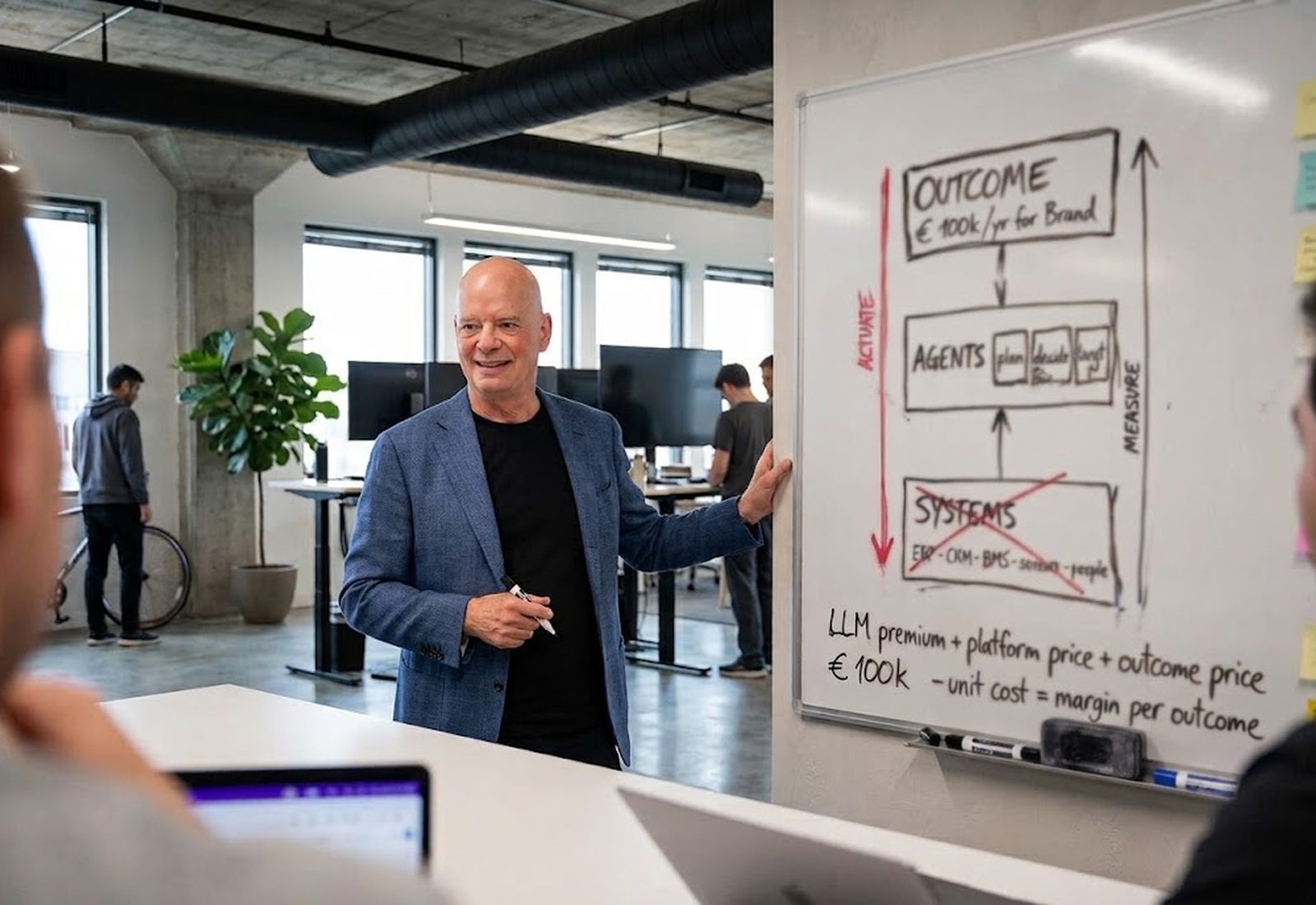
04Delete before you automate
The sequence matters more than the technology. Question every requirement. Delete the process that only existed to sell seats. Simplify what is left. Only then accelerate it, and only then automate it. Companies that skip to the last step automate waste at ten times the speed, and pay for the privilege.
The hard part is knowing what to delete. That is not an AI skill. It is an operating skill, and it comes from having built the thing you are now dismantling.
05The obstacles
Converting pricing without a revenue cliff. A sales organisation whose comp plan rewards the old unit. A roadmap built for screens rather than actions. Governance, because software that acts must be verified before it is permitted. And boards that want the AI story without the operating change that makes it real.
None of these are solved by a model. They are solved by a person who has run a company through a platform shift before, with their own number on the line.
06Where I stand
I came up in the client-server era, running regional P&Ls for Scala and Epicor in markets where the playbook did not exist. I then built the sales-led model at scale: Microsoft's Dynamics cloud from zero, SAP's first SaaS sales organisation in Europe, AVEVA's platform business from near zero to £81m. I know the seat model because I built it.
For the last five years I have run AI businesses with a P&L: C3 AI at Baker Hughes, where burn fell from $60m to $16m while revenue grew ten times; Core42, where margin went from 8% to 17% in a year; and cMatter, an agentic platform priced on the outcome. Most of what I built in the second era, I have since learned to delete. What survives is operations.
07The offer
If your seat revenue is repricing and your board wants the operating change, not just the story, I will tell you what to delete before you spend on AI, and then run the conversion. Thirty minutes is enough to know whether it is worth a second conversation.
Sources for the market figures: Deloitte TMT Predictions 2026 (Gartner data) on the shift of SaaS spend to usage, agent and outcome pricing; BCG, Rethinking B2B Software Pricing in the Agentic AI Era, on seat reduction as the primary buyer lever.